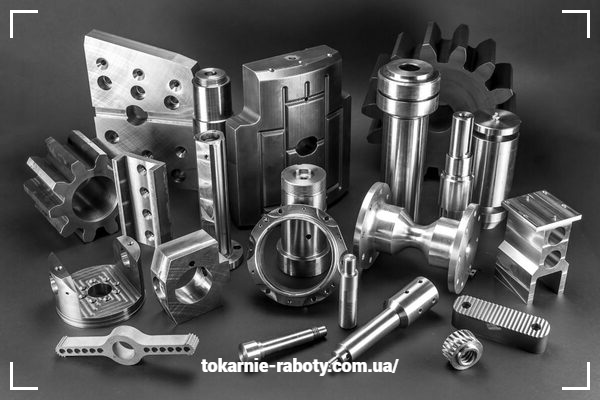
Turning Works with Steel
Steel is considered one of the most in-demand materials for turning operations. It is very strong, wear-resistant, and has high hardness, making it a universal choice for producing durable parts. However, these very characteristics create certain difficulties: when machining steel, it is necessary to correctly select cutting modes, tools, and spindle speed to avoid overheating and tool wear. Experienced turners know that for high-quality machining of steel, cooling must be applied, and strict adherence to technology is required. Steel is used for manufacturing shafts, gears, bushings, and other components that withstand heavy loads.
Turning Works with Aluminum
Aluminum is a relatively soft and lighter metal compared to steel, which simplifies its machining on lathes. Due to its plasticity, the material is easily subjected to turning, drilling, and cutting. The main challenge in working with aluminum is its tendency to stick to the cutting tool, which can result in a rough surface. To avoid such defects, the machinist uses special tool alloys, adjusts feed rates and spindle speeds. Aluminum is widely used for producing instrument housings, aviation parts, automotive components, and household appliances.
Turning Works with Stainless Steel
Stainless steel is a material with high corrosion resistance, widely used in the medical, food, and chemical industries. Its machining is more difficult compared to regular steel because stainless steel has increased toughness and hardness. During turning, the tool wears out more quickly, so stronger cutting inserts and precise cutting parameters are required. To achieve a perfect surface finish, the machinist applies minimal feeds and special cutting fluids (coolants). Finished stainless steel parts are durable and maintain their appearance even when exposed to aggressive environments.
Turning Works with Copper
Copper is a soft metal with high thermal and electrical conductivity. These properties make it indispensable in the electrical and heat exchange industries. During turning, copper behaves specifically: due to its softness, chips may smear, and a tool that is not sharp enough leaves burrs. For a quality result, the machinist uses perfectly sharpened cutting edges and low feed rates. Copper is often used for manufacturing conductive elements, fittings, and decorative details with a shiny surface.
Turning Works with Brass
Brass is an alloy of copper and zinc, known for its excellent machinability. Unlike pure copper, brass is harder and less prone to burr formation, allowing precise and clean surfaces to be achieved. When machining brass, the machinist must consider the alloy composition: the higher the zinc content, the harder the brass, and the more complex the cutting process. Brass components are widely used in plumbing, instrumentation, and furniture fittings. They have a beautiful golden shade and serve both functional and decorative purposes.
Turning of Plastic Parts
Plastic is increasingly used in industry and the production of various products. Its machining requires a special approach: at too high speeds, plastic may melt, while at too low speeds, it may crumble. It is important to maintain balance, use sharp tools, and, if necessary, cool the workpiece with air or liquid. Plastic is used for making bushings, gaskets, instrument housings, and equipment parts. Its lightweight and corrosion resistance make plastic an excellent choice for parts where weight savings are important.
Turning Works with Bronze
Bronze is an alloy of copper and tin (sometimes with other additives), distinguished by high strength, wear resistance, and excellent antifriction properties. For this reason, bronze is often used for manufacturing sliding bearings, bushings, and guides. In machining, bronze behaves more stably than pure copper, but still requires precise mode selection, as the material may produce long chips. The machinist takes into account the alloy composition and applies the right tools to achieve maximum accuracy.
Lathe Services in Kyiv and Across Ukraine
On the tokarnie-raboty.com.ua website, you can order turning works for metals and plastics of any complexity. Our team consists of skilled specialists with extensive experience who know how to select the optimal machining parameters for each material. We use modern lathes, including CNC machines, which ensure high precision and quality of finished parts. We offer an individual approach, producing both single custom pieces and batches of components for industrial production.
 ADDRESS
 PHONE
PHONE Email
Email