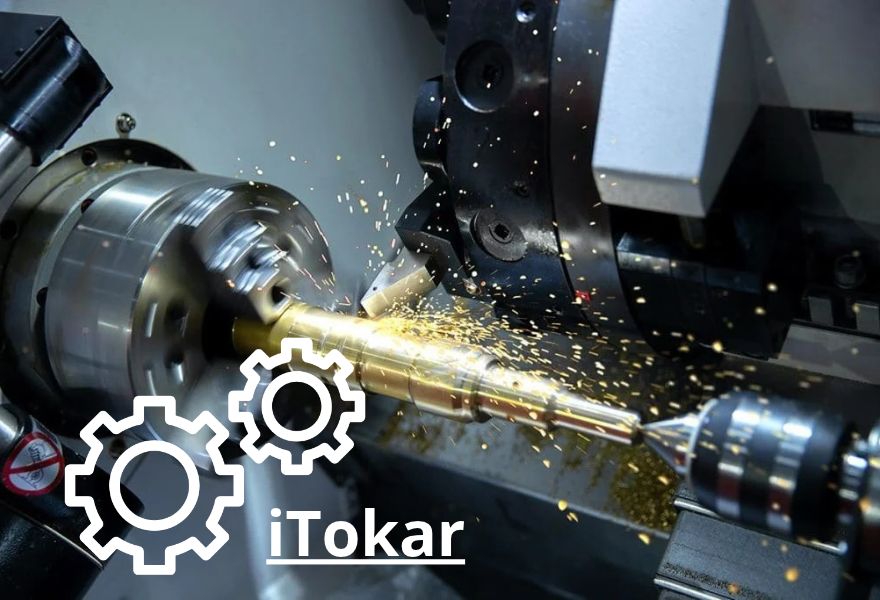
Custom Flange Manufacturing in Ukraine
We manufacture custom flanges to customer drawings, dimensions, sketches or sample parts. Our workshop produces metal flanges for industrial equipment, piping systems, pumps, gearboxes, machine tools and various other mechanisms in Ukraine. Turning allows us to precisely form mating surfaces, bores, steps and other features of the part. We take on both single pieces and small production batches.
What flanges are used for
A flange is a part used to connect structural elements, mount equipment, or secure individual assemblies. Its exact shape and dimensions depend on the intended application.
Flanges show up in all kinds of mechanisms and engineering systems - they're used to join pipes, mount equipment, and secure shafts and other components.
In practice, it isn't always possible to find a suitable standard flange: the required part may differ in diameter, thickness, hole placement, or the design of the mating surface. That's exactly when custom flange manufacturing becomes necessary.
Manufacturing flanges from drawings
Having a drawing makes producing the part much simpler - the technical documentation can specify the outer diameter, thickness, central bore diameter, bolt hole placement and other parameters.
That said, quality manufacturing depends on more than just overall dimensions. For some parts, the following are critical:
- accuracy of mating surfaces;
- bore concentricity;
- spacing between mounting holes;
- thickness of individual sections;
- surface roughness;
- tolerances.
These are the parameters that determine how precisely the finished flange will fit its intended assembly.
If there's no finished drawing, production is still possible from a sketch or sample part - in that case, the necessary dimensions and design features are worked out beforehand.
Turning a flange on a lathe
Turning is one of the primary methods used to manufacture metal flanges. It produces precise cylindrical surfaces, bores, grooves and mating sections.
The manufacturing process may involve:
- machining the outer diameter;
- boring the central hole;
- facing the surface;
- machining steps;
- cutting grooves;
- forming chamfers;
- thread cutting, if required.
Mounting holes may be added through additional operations depending on the design of the part.
Maintaining concentricity of the main surfaces during production matters a great deal - if the central bore or mating section is machined off-axis, the position of the connected components can shift after installation.
What materials are flanges made from
Material choice depends on the part's operating conditions. Depending on the task, this can mean structural or low-alloy steels, as well as various grades of stainless steel.
Stainless steel flange manufacturing is particularly relevant where the part is exposed to moisture, aggressive media, or where higher corrosion resistance is required.
When choosing a material, it's worth taking into account:
- mechanical loads;
- operating temperature;
- exposure to moisture;
- contact with chemicals;
- durability requirements;
- how the part will be processed further.
That's why, when placing an order, it helps to describe not just the dimensions of the part but also the conditions it will operate in.
When custom flanges make sense
Custom manufacturing is especially useful when standard parts don't meet the requirements of a specific mechanism.
A custom flange order may be needed when:
- a non-standard diameter is required;
- the holes follow a custom layout;
- a specific thickness is needed;
- the design has a stepped shape;
- the equipment is rare or discontinued;
- a standard part simply isn't available;
- a worn part needs to be replaced.
For repair work, manufacturing a single custom part is often more practical than a long search for the original replacement.
What's needed to manufacture a flange
The best option is to provide a drawing with a complete set of dimensions. But if documentation isn't available, that doesn't necessarily stand in the way of production.
For a preliminary assessment, you can provide:
- the old flange as a sample;
- a sketch;
- the main dimensions;
- photos of the part and its installation location;
- information about the material;
- the quantity needed.
Particular attention should go to mating dimensions and the layout of the mounting holes - if the old part has already suffered wear or deformation, its actual measurements may no longer match the original design.
That's why, when manufacturing a replacement, it's important to evaluate not just the sample part itself, but also the installation location.
Flanges for industrial equipment
Flanges are used across a wide range of industrial equipment, so requirements can vary considerably. Some parts only need standard turning, while others require a combination of several operations.
The quality of the finished part depends on choosing the right material, the right machining approach, and careful dimensional control - especially important for flanges operating under load or providing a precise connection between multiple components.
Turning allows us to manufacture everything from simple round flanges to parts with complex mating surfaces, steps and other structural features.
Custom flange manufacturing at iTokar
Manufacturing a flange requires precise dimensional control and a clear understanding of the part's function within its specific mechanism. That's why, before starting work, it's important to define the part's purpose, material, key dimensions and fit requirements.
We manufacture flanges to drawings, dimensions and sample parts, using modern equipment and checking the key parameters of every finished piece. We take on both individual orders and small production batches.
Our specialists' experience helps in selecting a practical machining approach based on the part's design and operating conditions - an approach that results in flanges that precisely match the requirements of the specific equipment they're built for.
For related metalworking tasks, see our page on turning and manufacturing shaft and bushing type parts - a closely related area of machining often used during repair and manufacturing work on the same mechanism.
Order Manufacturing
Click - Submit a Request.
See - Prices for Turning Services.
 ADDRESS
 PHONE
PHONE Email
Email